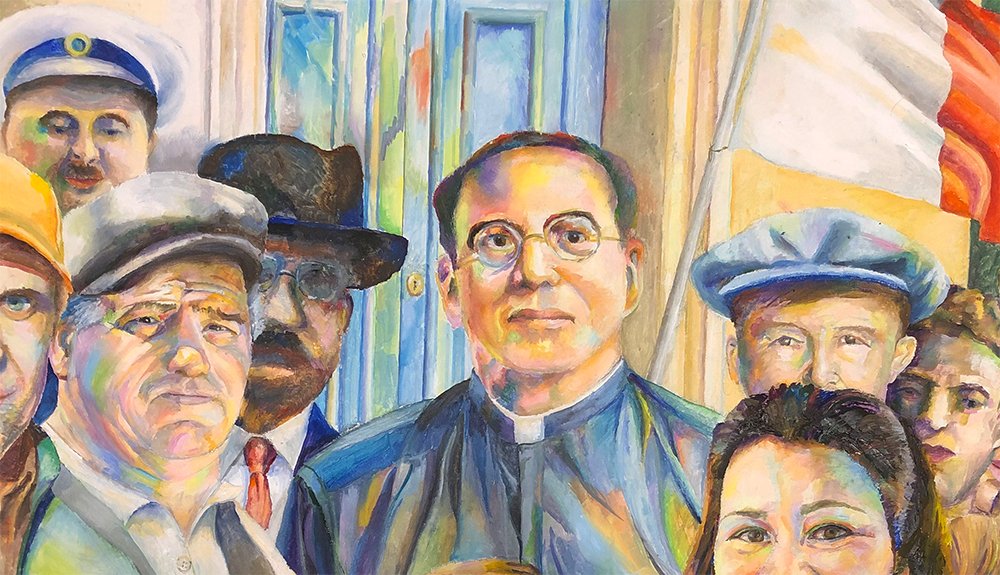

Soon, September 17th will mark the anniversary of the passing into Eternal Life of our Founder, Joseph De Piro – a day on which, God willing, we will celebrate his liturgical memory once he is declared a saint.
Recently, however, a question surfaced in my mind: Should we continue our efforts to see our Founder among the canonized saints of the Church?
This question stems from a real danger: canonized saints are often placed on pedestals, easily dismissed as being made of a “different stuff” than ordinary human beings, and thus unable to speak to us in our daily lives. Reading Robert Ellsberg, who has written extensively on the saints, brought this issue into focus. Ellsberg notes that for many of us, calling someone a saint conjures the image of a “plaster saint.” Quoting Thomas Merton, Ellsberg describes such figures as people “without the slightest moral flaw… whose intentions are the noblest… whose words are always the most edifying clichés,” presumed to be “without humour, as they are without wonder, without feeling, and without interest in the common affairs of mankind.”
Merton counters that holiness is actually a matter of becoming more fully human: “This implies a greater capacity for concern, for suffering, for understanding, for sympathy, and also for humour, for joy, for appreciation for the good and beautiful things of life.”
What a beautiful understanding of holiness – as a fullness of humanity! Ellsberg reinforces this by highlighting figures (some not even Catholic) who exemplified this fullness of humanity. To avoid the trap of assuming saints always thought, said, and did the perfect thing, Ellsberg prefers to define a saint simply as someone “who walked the path of holiness.” This brings sainthood much closer to home for each of us.
Pope Francis echoes this perspective in Gaudete et Exsultate:
“Not everything a saint says is completely faithful to the Gospel; not everything he or she does is authentic or perfect. What we need to contemplate is the totality of their life, their entire journey of growth in holiness, the reflection of Jesus Christ that emerges when we grasp their overall meaning as a person.” (GE 22)
To explore this further, I recommend watching Robert Ellsberg’s interview on his book “Blessed Among Us”:
The renown Butler’s Lives of the Saints defines sainthood as “the Gospel, clothed, as it were, in a body.” Our Founder offers a complementary insight: “The life of every saint is nothing less than a new page in the story of our love towards God.”
To be clear: I fully believe we should continue supporting our Founder’s cause for canonization. But let us not wait for an official decree to see how the Gospel was clothed in his humanity, or how his life added a page to God’s love story. Most importantly, let his example inspire us to take our own commitment to holiness seriously. For as Léon Bloy wrote, “The only real sadness, the only real failure, the only great tragedy in life, is not to become a saint.”
Your brother,
Fr Martin Galea mssp
Superior General.